








Removing manganese from groundwater at high flow rates
Groundwater is a vital source of drinking water across Australia, particularly where surface supplies are unreliable or remote communities are far from central treatment infrastructure. Yet bore water can contain dissolved manganese, iron, sediment, bacteria and other naturally occurring contaminants. Manganese may leave black staining on fixtures, create a metallic taste and accumulate as dark deposits in pipes, tanks and distribution networks.
Removing manganese from groundwater at high flow rates requires more than selecting a large filter vessel. The treatment process must convert dissolved manganese into a filterable form, provide enough contact with the treatment media, and maintain stable performance during peak demand. A carefully designed multi-media system can combine oxidation, catalytic filtration and solids capture while limiting chemical use, waste and energy consumption.
Why manganese is difficult to remove
Manganese commonly occurs in groundwater as soluble manganese ions, usually in a reduced form that can pass through ordinary sand filters. When the water is exposed to oxygen or another suitable oxidising condition, the manganese changes into insoluble manganese oxides. These particles can then be retained by a media bed. If the conversion stage is weak, increasing the flow rate will usually make the problem worse.
The chemistry of the bore supply has a direct effect on treatment. pH, alkalinity, dissolved oxygen, iron, hydrogen sulphide, organic matter and turbidity can all influence manganese removal. Iron may consume available oxidation capacity before manganese is treated, while fine clay or organic material can block the filter surface. A reliable design therefore begins with laboratory analysis and, where necessary, pilot testing under realistic flow conditions.
The Australian Drinking Water Guidelines provide an important reference for drinking-water projects, but the treatment target should also reflect the end use. A municipal supply, a cattle operation, a food-processing plant and a private rural property may have different flow patterns, storage arrangements and water-quality requirements.
How a multi-media bed works
A multi-media filter uses layers or combinations of materials with different functions. A support layer may stabilise the vessel and protect underdrains, while coarser media captures larger solids. Finer filtration media can retain suspended particles, and a manganese dioxide-based or catalytic layer can promote the conversion and capture of manganese. The arrangement is selected according to the raw-water profile rather than applied as a universal recipe.
In many systems, oxidation occurs before or within the filter. Aeration can add dissolved oxygen without continuously dosing a chemical oxidant. In other applications, a catalytic media surface supports oxidation as water passes through the bed. The treated manganese is held within the media until a backwash cycle removes the accumulated solids.
The media depth, grain size and loading rate must work together. A deep bed may provide greater contaminant capacity, but excessive depth can increase pressure loss. Very fine material may improve particle capture while reducing hydraulic capacity. High-flow manganese treatment is therefore a balance between removal efficiency, contact time, headloss and practical vessel dimensions.
Designing for high flow rates
High flow rates are best managed with several treatment vessels operating in parallel rather than forcing all water through one oversized or overloaded filter. Parallel vessels allow the system to maintain service while one unit is being backwashed. They also provide flexibility during periods of high demand, such as morning peaks in a regional town or irrigation-related use at a farm.
Hydraulic loading should be calculated from the chosen media and the actual raw-water conditions. A filter that performs well at a small laboratory flow may lose manganese removal efficiency when the bed is pushed too quickly. Engineers should assess empty bed contact time, filtration velocity, pressure drop and the expected solids loading, then size pumps, pipework and valves accordingly.
Backwash capacity is equally important. The process must expand and clean the media without carrying it out of the vessel. Backwash water, rinse water and drainage arrangements need to be considered early, particularly at remote sites where disposal options are limited. Automatic controls can monitor pressure differential, treated-water quality and operating hours to initiate cleaning at the appropriate point.
For Australian installations, temperature changes, long pipe runs and intermittent bore operation can affect performance. A system near Perth, for example, may face different groundwater chemistry and water restrictions from one serving a rural community in Queensland or an inland New South Wales property. Seasonal testing and a sensible storage strategy help prevent short-term demand spikes from destabilising treatment.
Protecting the process from fouling
Pretreatment can determine whether a manganese filter operates for years or suffers from rapid clogging. Screens, cartridge filters or an upstream multimedia stage may be appropriate when the bore carries sand, clay or oxidised iron. Where hydrogen sulphide or high organic content is present, the process may need additional aeration, adsorption or biological control.
Manganese media also requires suitable operating conditions. A water source with a low pH may need correction before filtration, while high iron concentrations can occupy the available treatment surface. The objective is not simply to add more media; it is to create a stable chemical environment in which the catalytic layer can remain active and backwashing can remove retained solids effectively.
Monitoring should include raw and treated manganese, iron, turbidity, pH, conductivity and pressure loss. Sampling at different points can show whether the issue is incomplete oxidation, exhausted media, channeling or inadequate backwash. This evidence makes maintenance more predictable and helps avoid replacing media before its useful capacity has been reached.
For projects involving councils, mines, livestock facilities or government infrastructure, documented water-quality records can also support compliance and operational accountability. A technical review with the supplier can clarify the expected contaminant load and operating conditions; a technical discussion is useful when bore analyses, flow diagrams and site constraints need to be assessed together.
Applying the technology across Australia
Manganese removal is relevant to many Australian settings. Remote communities may depend on a single bore and need robust equipment with limited operator intervention. Agricultural users may require clean water for stock, dairies or produce washing, while mining and construction sites can face changing groundwater quality as excavation progresses. Industrial facilities may also need to protect boilers, membranes and process equipment from manganese deposits.
Space, transport and commissioning conditions matter as much as filtration performance. A compact skid-mounted system can be more practical than a large permanent plant where access is restricted or the site is temporary. For emergency supply, infrastructure upgrades and isolated worksites, mobile treatment units can provide a treatment option that moves with the project.
Water conservation is another local consideration. Australian operators often need to limit backwash volumes, reuse suitable rinse water or schedule cleaning around storage capacity. Low-energy aeration, efficient pumps and automated valves can reduce operating costs, but energy savings should never come from compromising contact time or backwash quality.
The best system is built around the complete water cycle: bore abstraction, raw-water storage, oxidation, multi-media filtration, backwash management, treated-water storage and distribution. Once installed, the plant should be commissioned with verified flow and water-quality measurements rather than relying only on design assumptions. Regular servicing, media inspection and trend-based monitoring then keep manganese removal reliable during changing demand.
A properly engineered multi-media approach can deliver dependable manganese control at substantial flow rates without treating filtration as a single-step operation. Start with a representative bore analysis, define the required peak and average flows, and assess the space, power and backwash resources available at the site. Contact Swiss Cleanwater Group to discuss a treatment configuration suited to Australian groundwater, whether the need is a permanent plant, a remote installation or a mobile response system.
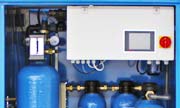
SCM 24
|
|
Cleans 24.000 liters per day
|
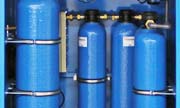
SCM 60
|
|
Cleans 60.000 liters per day
|
Video: How it works
The SCG Advantage
Our market-leading, water cleaning solutions have many advantages. To read more click the items below:
No Chemicals
Our machines and technology does not use any chemicals, at all.
Read more...
No Waste Water
Our machines do not waste any water. Yield = 100%.
Read more...
Low energy use
Uses 50 times less energy than a Reverse Osmosis Machine.
Read more...
Low ownership cost
Lower maintenance and operation costs due to our technology.
Read more...
Easy to install
Simple "plug and play" installation makes for easy deployment.
Read more...
Extremely compact
A compact system, contained in an easy to transport cabinet.
Read more...
Outperforms R.O.
SCG technologies outperform Reverse Osmosis systems.
Read more...
Faster ROI
Get a faster Return on Investment with our systems.
Read more...
Latest News
Latest Blog Posts
| Chemicals in water treatment? |
| Water storage - Whats best for keeping water clean and drinkable? |
| Case: Disaster Management Water Treatment |
Contact SCG
891 Showroom Place
Suite 101
Chula Vista, CA, 91914
Phone: +1 619-878-2730
Contact us by email