








Treating livestock water without chlorine across Australian stations
Across the rangelands that stretch from Longreach to the Pilbara, the daily task of checking troughs is one most graziers carry out at first light. Water in those concrete or poly tanks holds more than what meets the eye: bacteria, protozoa, sediment-bound viruses, and the occasional bloom of cyanobacteria that turns a trough emerald within a day. Many Australian operations still reach for chlorine to settle the question, yet the substance behaves unpredictably in organic-rich source water, leaves residues that buyers and auditors increasingly flag, and corrodes float valves over a couple of seasons. The chemical was designed for short municipal pipelines, not for thirty-kilometre poly runs that warm through a forty-two-degree day. Learn more about Treating Water For Hospitals Meeting Legionella Control Without Chemical Dosing.
Producers are responding. Beef operations in Queensland's Gulf, dairy farms along the Murray, and sheep stations west of Bourke are quietly shifting toward treatment trains that strip pathogens without dosing anything into the water. The drivers are practical: lower chemical-handling costs on remote properties, fewer withholding concerns, calmer supply chains for export-grade producers, and equipment that doesn't demand a weekly top-up from town.
Why chlorine falls short on the paddock
Free chlorine works through oxidation, which needs contact time, stable pH, and low turbidity. Trough water drawn from a dam after a storm in the Macquarie catchment arrives carrying enough suspended clay to neutralise the dose before it ever reaches a pathogen. In a clear artesian bore, chlorine combined with naturally occurring iron or manganese produces a stained biofilm that sloughs off and clogs drinker valves. For managers running several thousand head across a network of tanks, that recurring labour quietly erodes profit.
There are also biological limits. Cryptosporidium and many bacterial spores resist chlorine at the concentrations that remain palatable for stock, especially in heat. Foot-and-mouth and other viral risks have prompted producers near high-traffic saleyards to rethink their assumptions, and the science tends to favour physical removal or UV rather than chemistry.
How pathogens actually reach livestock troughs
Almost every contamination pathway on a station starts upstream of the trough itself. Algae mat on a dam wall near Cunnamulla sheds cells into the inlet when the wind swings. Birds on a tank cover deposit faeces that wash into the inlet during a downpour. Dust storms across the Liverpool Plains load the water with organic particles that shelter bacteria from any biocide added downstream. Identifying which entry point dominates is the first step toward a treatment train that does not require ongoing dosing.
When a pathogen is locked inside a particle or colonising biofilm on the inside wall of a pipe, chlorine struggles to penetrate at all. Filtration aimed at the right size fraction, combined with periodic turbulence to disrupt biofilm, can address what chemistry cannot.
Filtration-first approaches Australian producers are trialling
The cleanest results on extensive operations have come from filtration staged in descending micron grades, with no chemical stage in between. A pre-filter handling sediment down to roughly fifty microns protects the finer stages and extends their service life in clay-heavy bore water. Swiss-engineered multimedia units have shown particular resilience in trials across New South Wales and the Gascoyne, because their backwash triggers on differential pressure rather than a timer, which matters when water quality swings after summer storms.
Producers notice in the first month that the familiar green slick on the waterline takes far longer to appear, and leftover residue from previous chlorination flushes out gradually. Stock drink more consistently, which shows up as calmer weaner weights at the next muster. Over a season, the labour associated with cleaning troughs drops noticeably.
Membrane technologies reshaped for remote Australia
Membrane systems have matured to a point where remote installation is realistic. Ultrafiltration membranes, with pore sizes measured in fractions of a micron, physically exclude bacteria and most viruses while leaving minerals unchanged. Unlike reverse osmosis, they do not waste a large fraction of the supply as brine, which matters on a station where every megalitre is pumped from a limited aquifer. Properties around Toowoomba and the Adelaide Hills now deliver trough water that meets microbiological criteria without drums of hypochlorite.
The same physical-removal logic that suits livestock also translates to sensitive sites such as hospitals, where biofilm and pathogen control carry strict regulatory weight. Insights from those installations often guide agricultural design, and the connection is explored in a recent piece on legionella control that outlines how membrane-led systems are reshaping expectations. For Australian producers, the implication is straightforward: technology that safeguards patients from opportunistic pathogens can comfortably protect a herd of breeders on a station dam.
Managing algae, manganese, and biofilm in warm-climate dams
The Darling-Baaka and other northern rivers have shown producers just how fast an algal bloom can flip from curiosity to crisis. Cyanobacteria produce toxins that survive chlorination at trough concentrations and accumulate in the liver over repeated exposure. Once a bloom has taken hold, chemical treatment of an open dam is rarely feasible. The wiser investment sits at the trough inlet, where a properly sized membrane or fine-media stage can strip intact cells out of the water before stock ever drink.
Manganese behaves differently but creates similar headaches. It oxidises slowly at ambient temperature, staining troughs and drinker lines almost regardless of chlorine dosing. Selective media designed to capture manganese at the right oxidation state removes it at the front of the train, before it has a chance to plate out further down the system. Properties in the Hunter and irrigation districts of the Murray-Darling have installed these units specifically to end the brown staining that has dogged their header tanks for decades.
Field results and on-farm economics
Numbers from a cross-section of properties tell a consistent story. Beef weaners near Blackall recorded a measurable improvement in daily gain after a filtration-led upgrade, with the operation recovering capital cost within two sale cycles through reduced chemical purchases and lower mortality. A dairy herd near Warrnambool saw somatic cell counts drop noticeably within a single lactation, easing pressure on bulk-tank premiums. Sheep stations in western New South Wales report fewer losses during dry-season trough changes because new water entering the system no longer carries biofilm that previously triggered digestive upset.
The equipment is built to operate unattended for stretches of time, which matters when the nearest service technician is half a day's drive away over unsealed roads. Combined with remote monitoring that sends an alert when filters need attention, the operational burden is comparable to chemical dosing and, in most seasons, considerably lighter.
Producers curious about how a non-chemical train would suit their enterprise often start with a site assessment and a short pilot run on their worst-quality source. Requesting a free demo lets the team walk through bore water analyses, dam profiles, and herd size to size a system that pays its way. With the right architecture in place, Australian stations can deliver consistently clean trough water in any season, free from the chlorine drum and the compromises that come with it.
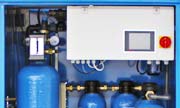
SCM 24
|
|
Cleans 24.000 liters per day
|
SCM 60

|
|
Cleans 60.000 liters per day
|
Video: How it works

The SCG Advantage
Our market-leading, water cleaning solutions have many advantages. To read more click the items below:
No Chemicals
Our machines and technology does not use any chemicals, at all.
Read more...
No Waste Water
Our machines do not waste any water. Yield = 100%.
Read more...
Low energy use
Uses 50 times less energy than a Reverse Osmosis Machine.
Read more...
Low ownership cost
Lower maintenance and operation costs due to our technology.
Read more...
Easy to install
Simple "plug and play" installation makes for easy deployment.
Read more...
Extremely compact
A compact system, contained in an easy to transport cabinet.
Read more...
Outperforms R.O.
SCG technologies outperform Reverse Osmosis systems.
Read more...
Faster ROI
Get a faster Return on Investment with our systems.
Read more...
Latest News
Latest Blog Posts
| Chemicals in water treatment? |
| Water storage - Whats best for keeping water clean and drinkable? |
| Case: Disaster Management Water Treatment |
Contact SCG
891 Showroom Place
Suite 101
Chula Vista, CA, 91914
Phone: +1 619-878-2730
Contact us by email