








Industrial cooling tower water treatment without biocides
Cooling towers reject heat by evaporating a portion of the circulating water. As water evaporates, dissolved minerals remain behind and become increasingly concentrated. Without effective control, this can lead to scale, corrosion, suspended solids, unpleasant odors, blocked heat-transfer surfaces, and microbiological growth.
Biocides have traditionally been used to suppress bacteria, algae, and fungi in open recirculating systems. However, some facilities are seeking alternatives because of discharge restrictions, worker-safety concerns, chemical handling requirements, and the environmental impact of treatment residues. A biocide-free strategy does not mean leaving microbial risk unmanaged. It means combining water quality control, physical separation, system design, and continuous monitoring.
Industrial cooling tower water treatment without biocides is most successful when it is designed around the make-up water, operating cycles, tower configuration, heat load, and discharge requirements. The objective is stable heat transfer with lower chemical dependence and controlled water consumption.
Why conventional cooling water becomes unstable
Evaporation increases the concentration of calcium, magnesium, silica, chlorides, sulfates, and other dissolved substances. When these constituents exceed their solubility limits, they can form deposits on fill material, condenser tubes, plate heat exchangers, and spray nozzles. Even a thin scale layer can reduce heat-transfer efficiency and increase energy demand.
Suspended particles create a second problem. Dust, rust, process leaks, and airborne debris enter the basin and circulate through pumps and heat exchangers. These solids can settle in low-flow areas, shelter microorganisms, and accelerate under-deposit corrosion. High conductivity may also indicate that blowdown is overdue, while low flow or poor distribution can create stagnant zones.
Microbial contamination requires particular attention. Warm, nutrient-rich water and wet surfaces can support biofilm formation, including organisms associated with Legionella risk. A non-biocide program must therefore include a documented water management plan, regular inspection, cleaning, sampling where appropriate, and operational controls aligned with local regulations.
Physical methods that replace routine biocide dosing
Side-stream filtration is one of the most practical tools for reducing the solids that support fouling and biological growth. A portion of the recirculating water passes through a filter while the rest continues through the tower. Depending on the application, this may involve multimedia filters, cartridge filters, automatic self-cleaning screens, or specialized membrane systems.
Removing suspended solids improves basin cleanliness and reduces the surface area available for biofilm development. Filtration does not sterilize the water, so it should be combined with good circulation, prompt removal of sludge, and suitable tower cleaning. Automatic backwashing can reduce operator workload and prevent a loaded filter from becoming a new source of contamination.
Ultraviolet treatment can inactivate microorganisms as water passes through a properly sized reactor. It works best when turbidity and color are low because particles can shield microorganisms from UV light. Ozone and advanced oxidation may also be considered in some systems, although they require careful engineering, off-gas management, compatible materials, and monitoring. These technologies should be evaluated as part of a complete treatment train rather than treated as universal replacements.
Controlling scale, corrosion, and dissolved contaminants
Biocide-free operation still requires control of dissolved minerals. Reverse osmosis, nanofiltration, electrodeionization, and selected ion-exchange processes can reduce the concentration of scale-forming substances in make-up water. Softening may be suitable where hardness is the dominant concern, while membrane treatment can address a broader range of dissolved contaminants.
The correct approach depends on feed-water chemistry. A cooling tower using municipal water may need a different system from one supplied by a borehole, river abstraction, or treated industrial effluent. Detailed analysis should include hardness, alkalinity, silica, chloride, sulfate, iron, manganese, total dissolved solids, pH, and microbial indicators.
Special contaminants can affect equipment selection and waste handling. For facilities working with mining water or contaminated groundwater, guidance on uranium filtration media can help inform pretreatment decisions before water enters a cooling circuit. Removing problematic constituents upstream may protect heat exchangers and reduce the burden on tower blowdown treatment.
Comparing treatment approaches
No single technology provides complete protection for every cooling tower. A robust design normally combines several barriers: clean make-up water, solids removal, controlled concentration, reliable circulation, hygienic maintenance, and monitoring. The table below summarizes the role of common options.
| Treatment approach | Main function | Strengths | Key limitations |
|---|---|---|---|
| Side-stream filtration | Removes suspended solids | Reduces fouling and basin sediment; suitable for continuous operation | Does not remove dissolved salts or eliminate all microorganisms |
| Multimedia filtration | Captures a range of particle sizes | Effective for turbid make-up or recirculating water | Requires backwash water and periodic media maintenance |
| UV disinfection | Inactivates microorganisms in flowing water | No residual chemical added; rapid treatment | Needs clear water, correct dose, and reliable flow |
| Reverse osmosis | Reduces dissolved salts and scale precursors | Supports higher cycles of concentration and lower blowdown | Produces a concentrate stream and needs pretreatment |
| Softening | Removes hardness ions | Useful against calcium carbonate scaling | Does not address all dissolved contaminants or microbial risk |
| Magnetic or electrostatic devices | May influence particle behavior in some conditions | Low consumables and simple installation | Performance is application-dependent and should be validated |
| Ozone or oxidation | Controls certain organic and microbial loads | Can support difficult water-quality programs | Requires specialist design, safety controls, and material compatibility |
Water reuse and discharge management
A biocide-free cooling strategy can reduce the chemical content of blowdown, making reuse or further treatment easier. However, concentration cycles still determine how much water leaves the system. Higher cycles may reduce freshwater demand, but they also increase the concentration of salts and corrosion-promoting substances.
Where discharge limits are strict, filtration, membrane concentration, evaporation, or crystallization may be needed. The feasibility depends on flow rate, contaminant loading, energy availability, and the desired recovery rate. Facilities assessing advanced recovery can review whether zero-liquid discharge is achievable for smaller treatment applications before committing to a full system.
Water reuse should also account for contaminants introduced by the industrial process. Oil, ammonia, metals, organic compounds, and cleaning residues can make cooling tower blowdown unsuitable for direct reuse without targeted pretreatment. A water balance that tracks make-up, evaporation, drift, blowdown, filter backwash, and treatment concentrate is essential for accurate planning.
Monitoring makes chemical-free treatment reliable
Continuous conductivity measurement is commonly used to control blowdown and maintain a target concentration ratio. Online pH, temperature, flow, turbidity, oxidation-reduction potential, and differential pressure across filters can provide additional insight. Alarms should identify low circulation, high turbidity, blocked filtration, abnormal conductivity, or loss of UV intensity.
Routine sampling remains important because sensors do not measure every failure mode. Operators should inspect tower basins, fill, drift eliminators, spray nozzles, strainers, and heat-exchanger surfaces. Microbiological testing should be established according to the site risk assessment and applicable health and safety guidance.
Data becomes useful when it is connected to action limits. For example, rising turbidity may trigger filter inspection, increasing conductivity may initiate controlled blowdown, and a sudden temperature change may indicate reduced heat-transfer performance. Trend analysis can reveal deterioration before deposits or microbial problems become visible.
Designing the system around the facility
The best treatment train begins with a survey rather than a standard equipment package. Engineers should establish the tower’s circulating flow, basin volume, evaporation rate, cycles of concentration, make-up source, seasonal temperature range, and heat exchanger materials. They should also identify whether the system serves a hospital, food plant, data center, manufacturing site, livestock facility, or another environment with distinct hygiene and continuity requirements.
Retrofitting may involve a side-stream filter, UV reactor, softened or membrane-treated make-up water, automatic blowdown control, basin cleaning, or improved circulation. In some cases, replacing dead legs and correcting poor spray distribution delivers greater benefit than adding another treatment device. Materials must be compatible with the selected water chemistry, especially where conductivity, oxidation, or reclaimed water is involved.
A phased approach can reduce operational risk. Start with a water analysis and baseline performance assessment, install the highest-value control, then verify conductivity, pressure drop, microbial indicators, heat-transfer efficiency, and blowdown volume. This creates evidence for further investment and helps operators understand how the system responds to changing loads.
Practical priorities for implementation
A successful program should balance environmental goals with public-health protection, equipment reliability, and operating simplicity. The following priorities help turn a non-biocide objective into a controlled engineering program:
- Analyze make-up and circulating water before selecting filters, membranes, UV, or other equipment.
- Remove suspended solids continuously or at regular intervals through appropriately sized side-stream filtration.
- Maintain strong circulation, eliminate stagnant zones, and schedule basin and tower cleaning.
- Use conductivity and flow controls to manage cycles of concentration and prevent uncontrolled mineral buildup.
- Establish documented microbiological monitoring, inspection routines, response thresholds, and site-specific safety procedures.
When these measures work together, a cooling tower can operate with far less dependence on conventional biocides while preserving heat-transfer performance. The goal is not simply to remove one product from the chemical program. It is to create a cleaner, measurable, and resilient water-management system.
Swiss Cleanwater Group can support this process with water-treatment technologies, filtration expertise, and application-specific system design. Begin with a site water analysis and cooling-tower assessment to identify the appropriate treatment combination for reliable, lower-impact operation.
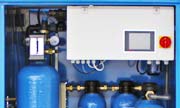
SCM 24
|
|
Cleans 24.000 liters per day
|
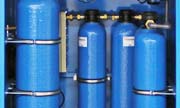
SCM 60
|
|
Cleans 60.000 liters per day
|
Video: How it works
The SCG Advantage
Our market-leading, water cleaning solutions have many advantages. To read more click the items below:
No Chemicals
Our machines and technology does not use any chemicals, at all.
Read more...
No Waste Water
Our machines do not waste any water. Yield = 100%.
Read more...
Low energy use
Uses 50 times less energy than a Reverse Osmosis Machine.
Read more...
Low ownership cost
Lower maintenance and operation costs due to our technology.
Read more...
Easy to install
Simple "plug and play" installation makes for easy deployment.
Read more...
Extremely compact
A compact system, contained in an easy to transport cabinet.
Read more...
Outperforms R.O.
SCG technologies outperform Reverse Osmosis systems.
Read more...
Faster ROI
Get a faster Return on Investment with our systems.
Read more...
Latest News
Latest Blog Posts
| Chemicals in water treatment? |
| Water storage - Whats best for keeping water clean and drinkable? |
| Case: Disaster Management Water Treatment |
Contact SCG
891 Showroom Place
Suite 101
Chula Vista, CA, 91914
Phone: +1 619-878-2730
Contact us by email